

“Carmina Burana” revealed (part 1). On April 25, my first article dealing with the timpani and percussion parts in “Carmina Burana” (Carl Orff) was published on the GROVER PRO website. You can read it HERE. I hope you enjoy it. Please stay tuned for the next articles in the series. …et in… Continue reading Carmina Burana revealed (part 1)

Category: History
Articles dealing with the rich history of percussion instruments.
Dresdner Apparatebau Jähne & Boruvka timpani

Dresdner Apparatebau Jähne & Boruvka timpani. I have been wanting a pair of timpani suitable for playing the repertoire of the 19th-century for quite some time so, because I have been a very good boy, I decided to include them in my letter to the Three Wise Men. To my surprise, Melchior, Caspar and Balthazar… Continue reading Dresdner Apparatebau Jähne & Boruvka timpani
“Scheherezade”, roll or articulate?

“Scheherezade”, roll or articulate? Despite being one of the milestones in the symphonic repertoire, “Scheherezade” features, believe or not, many mistakes and misprints. Belaieff (I have already mentioned him in previous articles) published the score and parts in 1899 in Leipzig. Since then, we have played using the exact same edition: 135 years perpetuating the… Continue reading “Scheherezade”, roll or articulate?
Timpani in “Messiah”.

Timpani in “Messiah”. We are getting very close to “Messiah season” so, why not having a look at this perennial classic? This year I will be playing timpani for the Christmas concert while my colleagues are in the pit playing “Aida”. I have started preparing for the rehearsals and I have found some interesting… Continue reading Timpani in “Messiah”.
“Xilofono basso” in “Turandot” (G. Puccini) – (and II?)

“Xilofono basso” in “Turandot” (G. Puccini) – (and II?). In my PREVIOUS ARTICLE I showed you which instrument wanted Puccini as the “xilofono basso”, where he found his inspiration, who provided him with he original instrument and how he ordered a copy to be made for “Turandot”. Just imagine that we could find that original… Continue reading “Xilofono basso” in “Turandot” (G. Puccini) – (and II?)
“Xilofono basso” in “Turandot” (G. Puccini).

“Xilofono basso” in “Turandot” (G. Puccini). “Turandot”, by Giaccomo Puccini, is scored for timpani, snare drum, bass drum, cymbals, tam-tam, tubular bells, glockenspiel (keyboard), tuned gongs (the same as in “Madama Butterfly”), triangle, xylophone and bass xylophone in the pit; a tam-tam and a temple block onstage. I will write about the tuned gongs in… Continue reading “Xilofono basso” in “Turandot” (G. Puccini).
Tchaikovsky´s “Arabic Dance” – Articulate or roll?
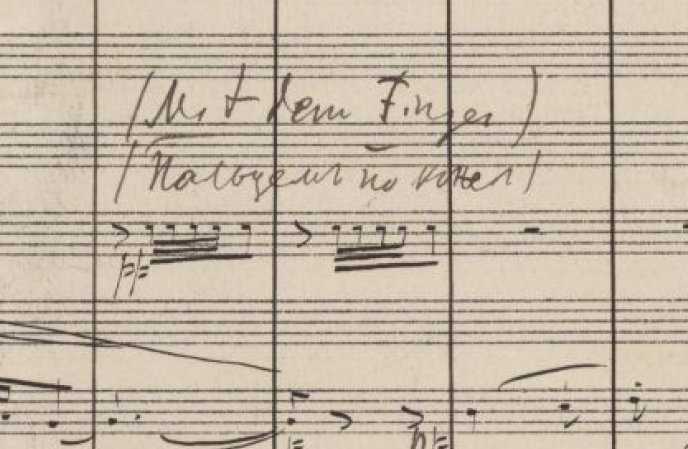
Tchaikovsky´s “Arabic Dance” – Articulate or roll? Last December 27 my article on the tambourine part of Tchaikovsky´s “Arabic Dance” (from “The Nutcracker”) was published on the Grover Pro website. You can read it clicking on the banner below: Thank you very much to Svetlana Manakova for helping me to translate the Russian indications. …et… Continue reading Tchaikovsky´s “Arabic Dance” – Articulate or roll?
“Histoire du Soldat”, what about the “L´”?

“Histoire du Soldat”, what about the “L´”? “Histoire du Soldat”, by Igor Stravinsky, is one of the most important works in the percussion repertoire, as it was one of the first to be written for a percussion set. Apart from its “percusive” importance, it is a masterwork which is played very often (whether staged or… Continue reading “Histoire du Soldat”, what about the “L´”?
Herd bells in “Tosca”.

Herd bells in “Tosca”. I have been to Rome lately, where I have spent some wonderfull days together with my family. Among many other places of general and musical interest, I have been to the Castel Sant´Angelo. The third act of “Tosca” takes place at this impresive building. More precisely at the upper platform. LA… Continue reading Herd bells in “Tosca”.
How I made some snare gates

How I made some snare gates. A snare gate is an opening in the lower counterhoop that allows for the snares to pass through it and to make contact with the resonant head. See the opening in the lower counterhoop, right below the snare strainer. © Grover Pro Percussion View from below. Check the snares… Continue reading How I made some snare gates