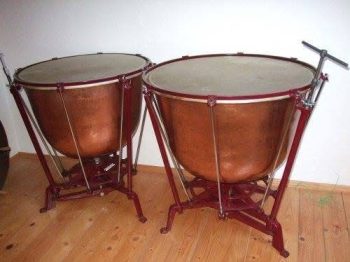
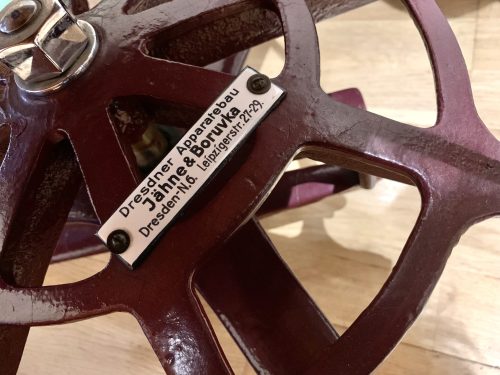
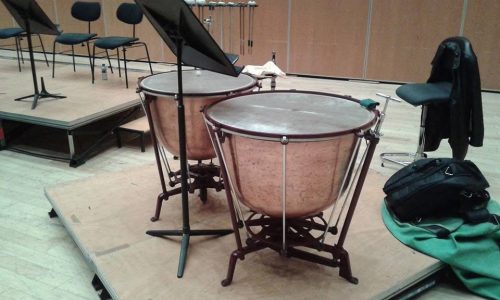
I have been wanting a pair of timpani suitable for playing the repertoire of the 19th-century for quite some time so, because I have been a very good boy, I decided to include them in my letter to the Three Wise Men. To my surprise, Melchior, Caspar and Balthazar presented me with a wonderful pair of Jähne & Boruvka drums.
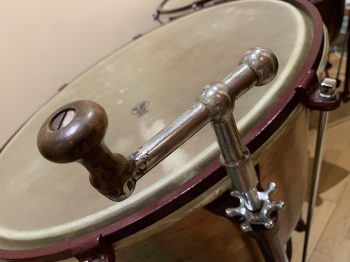
This kind of timpani is known as “kurbelpauken” (“crank timpani”), as the tuning is done via only one of these devices. The tension rods are connected to the spider at the base, which pulls and pushes the counterhoop when using the crank. Of course, this mechanism allows for a much quicker, precise and uniform change of the pitches when compared to baroque timpani.
They are also known as “salonpauken” (“salon timpani”), as their reduced size made them ideal for chamber orchestras playing in small theatres or palaces.
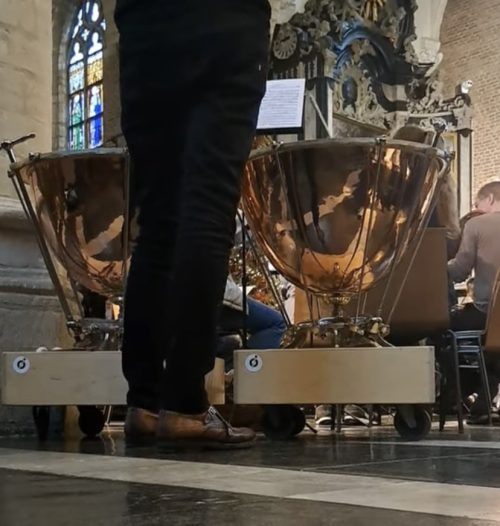
Mine are 69 and 61.5 cms in diameter (around 27″ and 24″). They are small, but they are capable of a very ample range. The large one can go down to a low F without problem, and the small one can produce a very nice high f sharp (perfect for Schubert´s “Unfinished” symphony”). They are only 78 cm. high, which makes me think that they were designed to be played on risers, like the Italian drums by Boracchi and others.
Marinus Komst playing on raised timpani.
They are fitted with brand new Super Kaldo heads, but I would also like to try goat.
The legs feature holes so you can mount either casters or spikes.
A you may imagine, I am very much looking forward to try them with an orchestra.
Do not hesitate to contact me should you need more information regarding these drums or want to play on them.