Despite being one of the milestones in the symphonic repertoire, “Scheherezade” features, believe or not, many mistakes and misprints. Belaieff (I have already mentioned him in previous articles) published the score and parts in 1899 in Leipzig. Since then, we have played using the exact same edition: 135 years perpetuating the many mistakes of that first printing! For more than one century no one has cared to correct them, and subsequent editions are mere reprints, so they feature the exact same mistakes as the original.
It is very possible (in fact I am quite sure) that this is the cause of the doubtful interpretations of this work, but this article won´t deal with the mistakes in the edition but with the interpretation of some specific passages in the snare drum part. It is quite obvious that the particella does not help but, again, it gets revealed how few percussionists like studying the score.
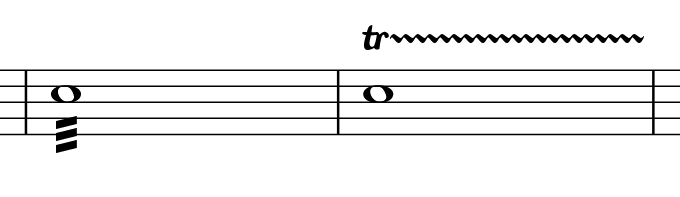
There is a classic problem; namely, the use of two different notations to, in many cases, indicate the same thing: a roll. We have the slashes or the tr indication followed by a wavy line.
Let us leave aside the fact that these two notations meant, indeed, two different things during the Classical and Romantic periods. The first one indicated a double stroke roll and the second one a press roll. Yes, that diference existed, but that is not the purpose of this article: when Rimsky-Korsakov wrote “Scheherezade” there was already no diference and both mean the same, a roll (hand to hand on timpani, a buzz roll on snare drum). The problem is that both notations were used indistinctly on the same part, which leads to confusion.
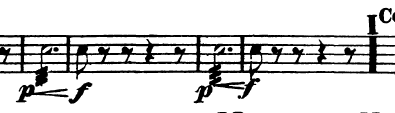
We can see here a roll in the third movement written using slashes:
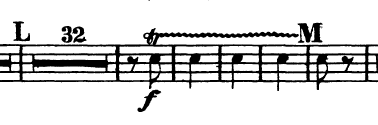
This is a roll in the fourth movement using the indication tr:
As you can see, a roll is indicated in two different ways. Further more, the slashes are also an abbreviation (one slash=eighth-notes; two slashes=sixtenth-notes; three slahes=thirtysecond-notes and so on) and Rimsky-Korsakov also uses that writing, so we have a big problem.
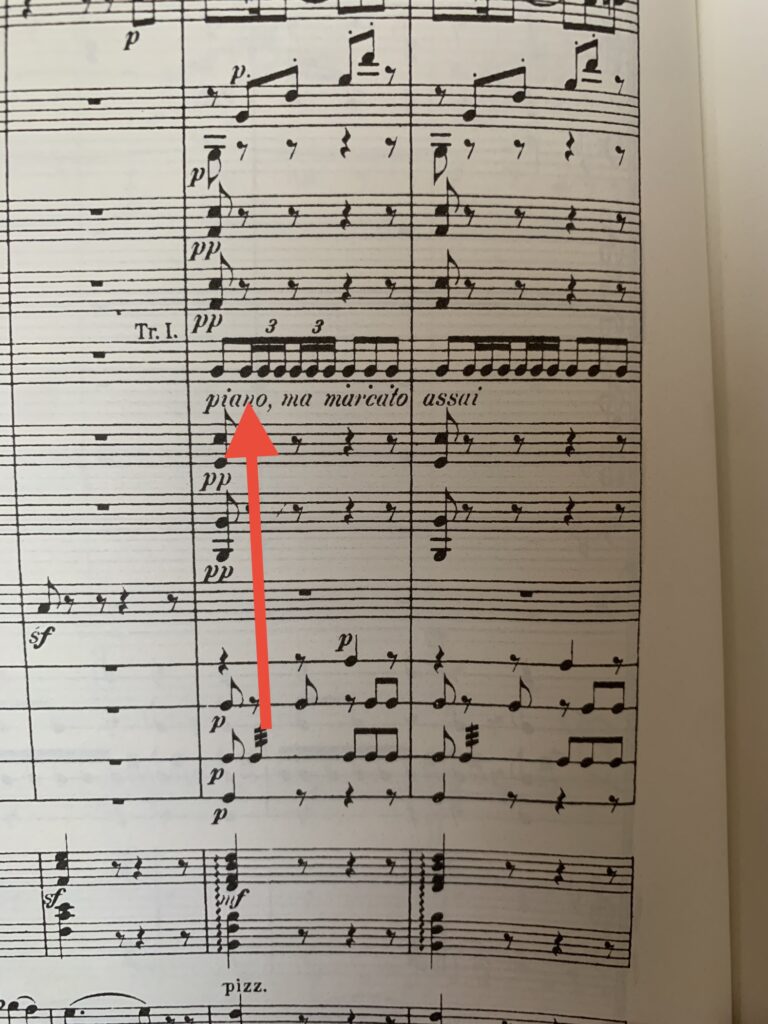
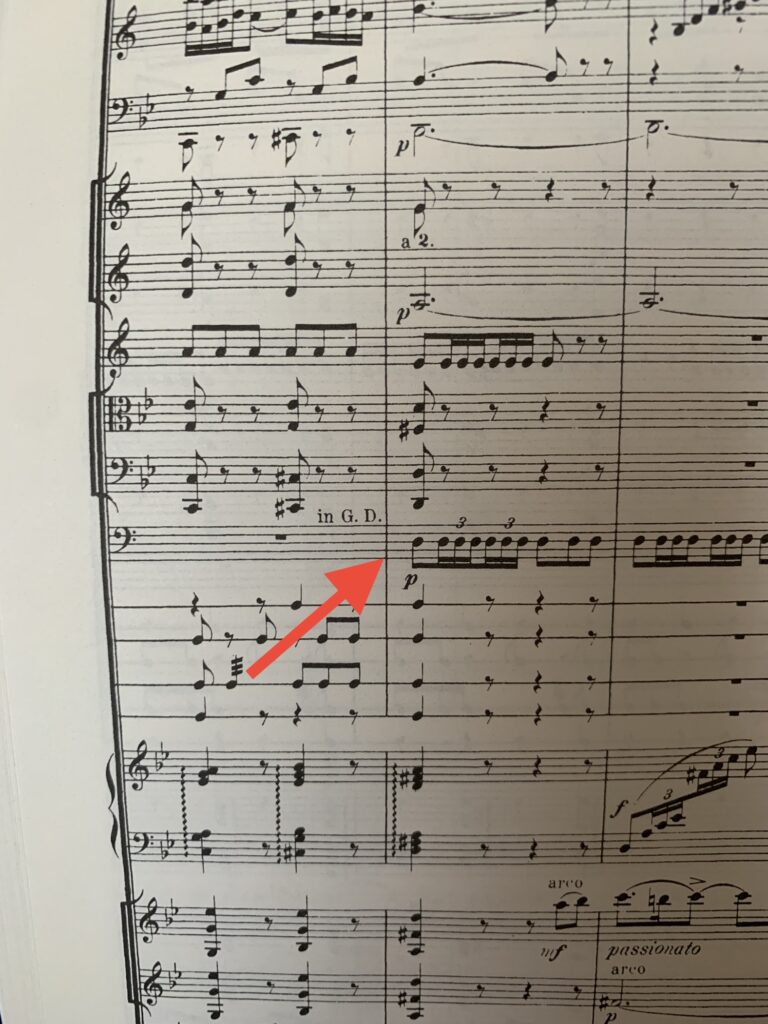
At letter Q in the fourth movement we can find slashes:
Obviously, that is not a roll, it is an abbreviation to indicate a precise rhythm, as we are doubling the trumpets and the French horns.
The same happens at letter T, where we are doubling the first trumpet:
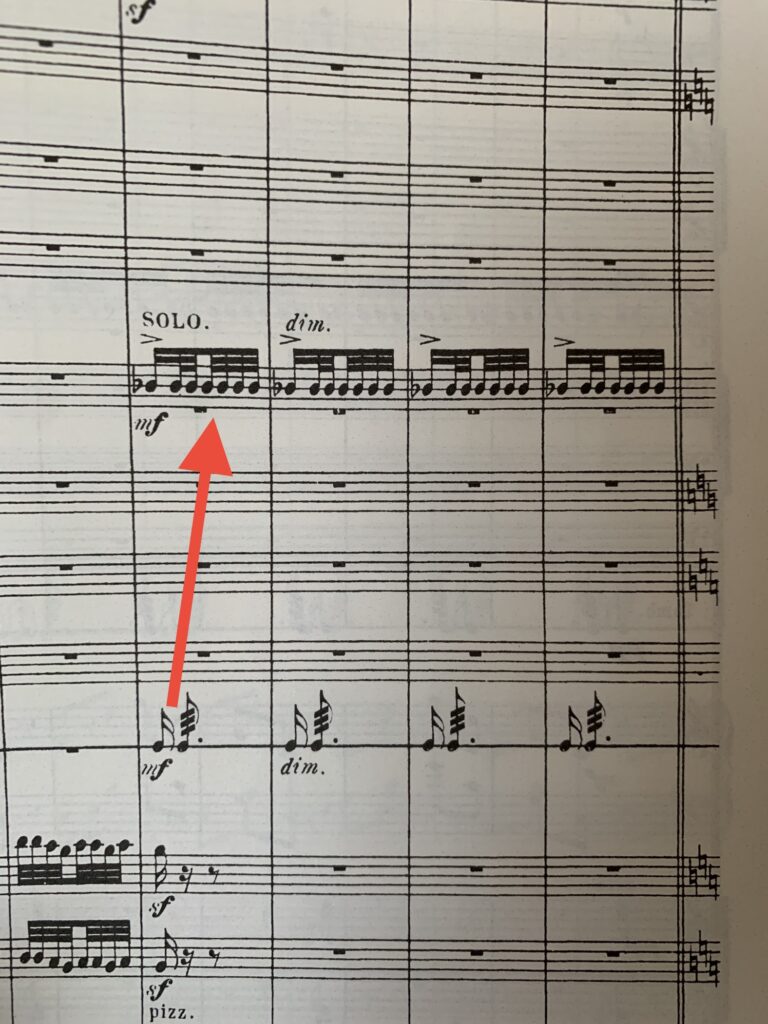
We must know when the slashes indicate to play a roll or a precise rhythm together with the instruments that we are doublling. The problem is that we are not consistent and, at letter G in the third movement, the interpretation tends to be a roll when it should be a rhythm because, as above, we are doubling a very precise, rhythmical pattern by the trumpet:
We are, again, playing with the solo trumpet but, instead of playing the same rhythmical pattern as in the two examples above, many percussionists interpret it as a roll. My opinion is that we are in the presence of an abbreviation indicating two sixteenth-note triplets.
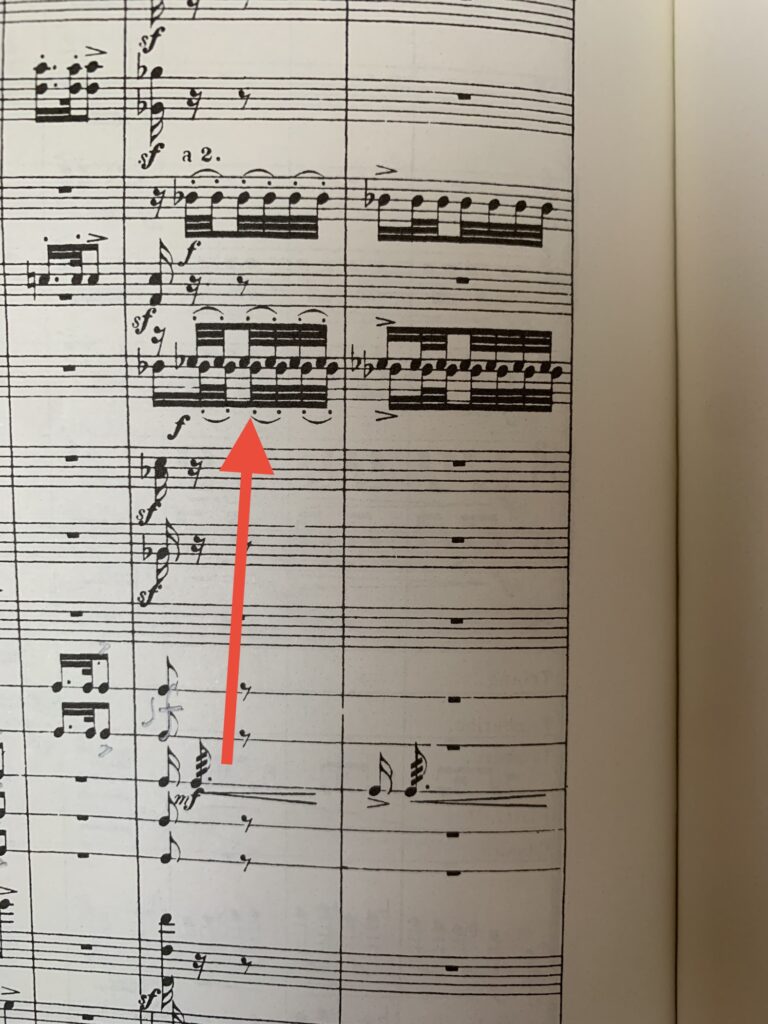
Not only that… For the timpani playing that exact same rhythm in the following phrase accompanying “cascades” of triplets in the rest of the orchestra proves, to me, that the snare drum should also play that pattern:
As you can see, Korsakov´s writting is very consistent when it comes to doubling the trumpets: slashes. It is us, percussionists, that are not, as we play the third movement as a roll and rhythmically the fourth one. We should play consistently in both cases. The writing and the musical situation is exactly the same, so we should play consistently in those situations.
Writing triplets, even writing a simple “3” about the figures, is hard work for the typesetter in charge of preparing the printing plate, and that is why it is ommited: time and money is saved. Note that there are many other passages in “Scheherezade” where the “3” above the figures is omitted, as they are understood, there is no doubt about them and it saves hard work when typesetting. The exact same thing at G: they are ommited becuase of a mere typesetting issue, but they are understood because we are doubling the trumpets.
We are interpreters, not readers. We have to interpret, listen, pay attention to what the other instruments are doing and use logic and common sense to get to he most musical solution possible. I know that it is very hard to change embedded habits and things that are taken for granted, but we, as artists, have to question things and do not let ourselves be carried away by the tide or unquestioned habits.
On the other hand, le us be practical. 1) The vast majority of conductors won´t be able to tell the difference. 2) If you are playing snare drum you are the principal, so you do not have to justify to anyone. Make musical decisions without fear. At the end of the day, rightly or wrongly, our musical decisions do not kill anybody (they would if we were heart surgeons, but we are not) and they vanish in time when the music stops.
My interpretation at letter G is to play sixteenth-note triplets together with the trumpet. Which is yours? You can download my edition of the snare drum part in the following link:
…et in Arcadia ego.
© David Valdés