We are getting very close to “Messiah season” so, why not having a look at this perennial classic?
This year I will be playing timpani for the Christmas concert while my colleagues are in the pit playing “Aida”. I have started preparing for the rehearsals and I have found some interesting things, which is what this articled deals with. You can find my own edition at the bottom.
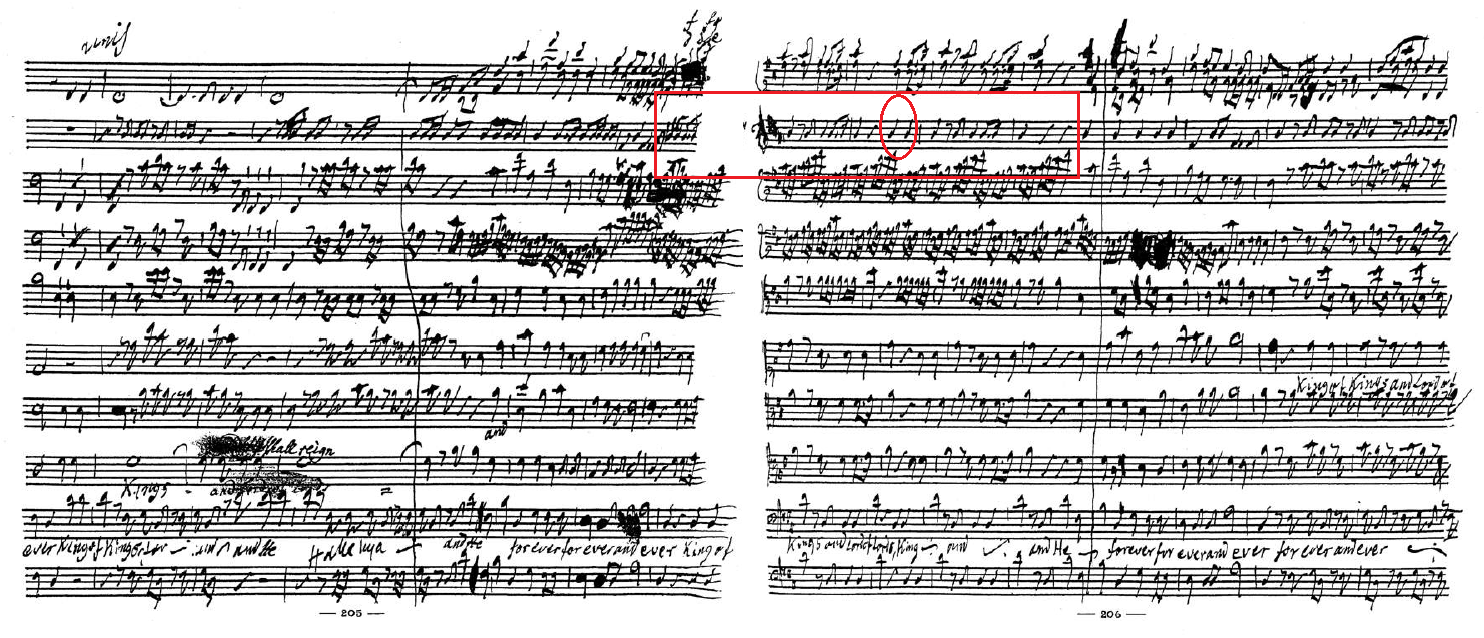
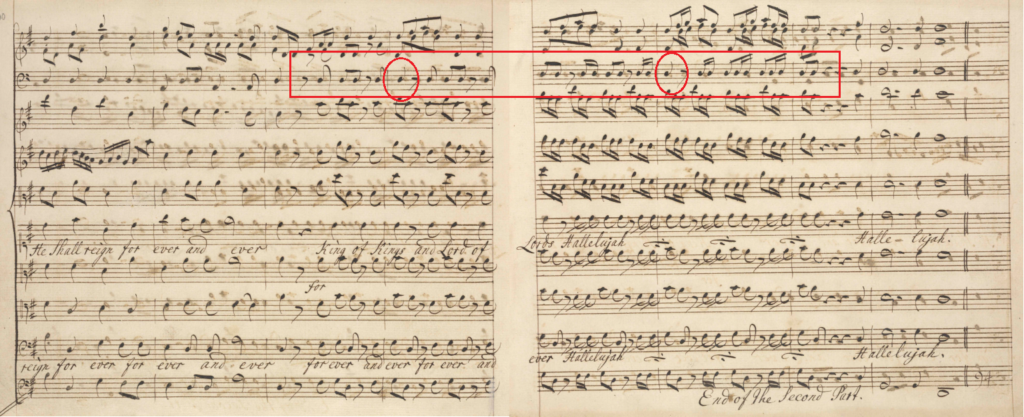
There are several spots in the super-famous “Halellujah” chorus that do not sound ok to me. It seems like if something was missing or as if I was playing wrong, so I decided to check the manuscripts (I say “manuscripts” because, as far as I know, three of them exist). I started with the oldest one, dating back to 1741. The passage, marked with a rectangle, contains two quarter-notes, marked with a circle:
At that time, timpani, still influenced by the cavalry tradition, were very closely tied to trumpets. Trumpets and timpani played together almost always and timpani used to double rhytmically the low trumpet part.
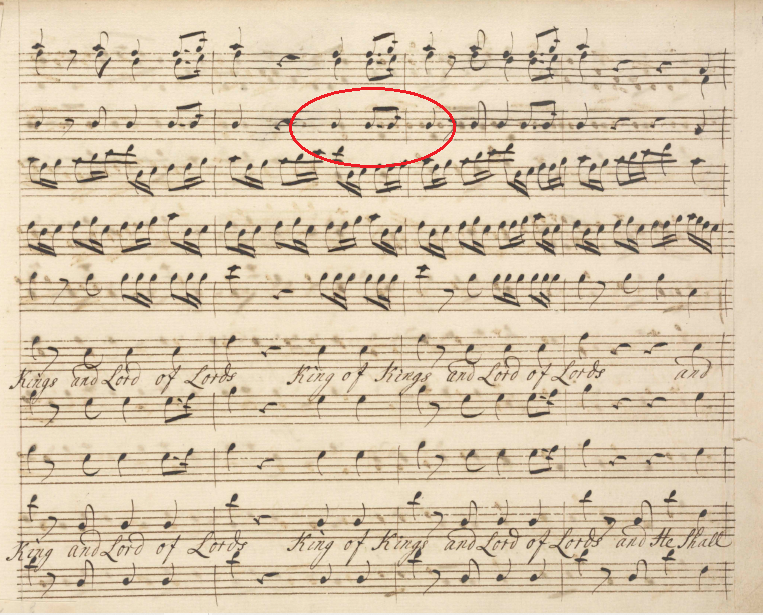
As you can see, the phrase above is repeated twice. The trumpets play exactly the same thing on both occasions, but the timpani, instead of playing the same rhythm twice (dotted eight-note/sixteenth-note), play a quarter-note in the repeated phrase (circled in the photo above). Playing the exact same two phrases in a different way than the trumpets do feels weird to me and it seems as if the timpanist was making a mistake. That made me suspect that we were in the presence of a “misprint”, so I checked the 1743/46 manuscript:
Bang. That same passage, written by Händel a few years later, perfectly doubles the trumpets, which confirms my suspicions. See that what was a quater-note in 1741 has became a dotted eighth-note/sixteenth-note rhythm in 1743, playing in rhythmical unison together with the trumpets.
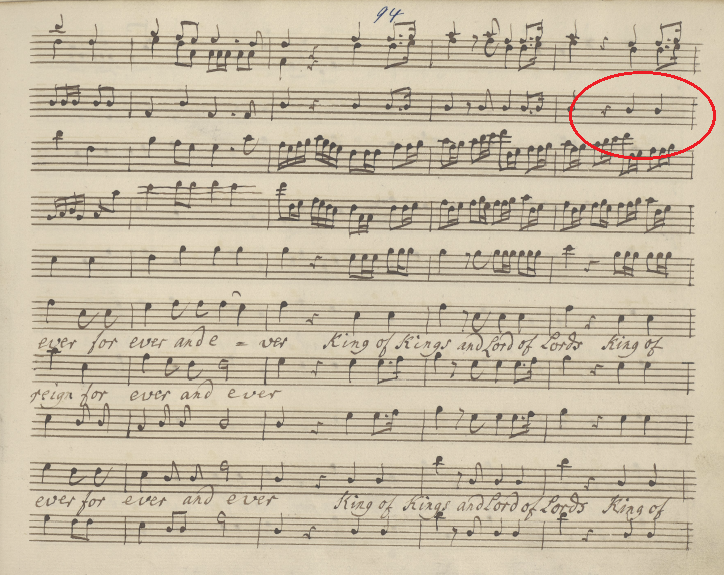
But, the problem arises again when checking the 1759/63 manuscript:
We find, again, those two quarter-notes instead of doubling the trumpets. As we already have the precedent of a discrepancy in one of the manuscripts, and because I believe that it is more logical and musical to play the same rhythm as the trumpets do, my edition abides to the 1743 version (the dotted rhythm).
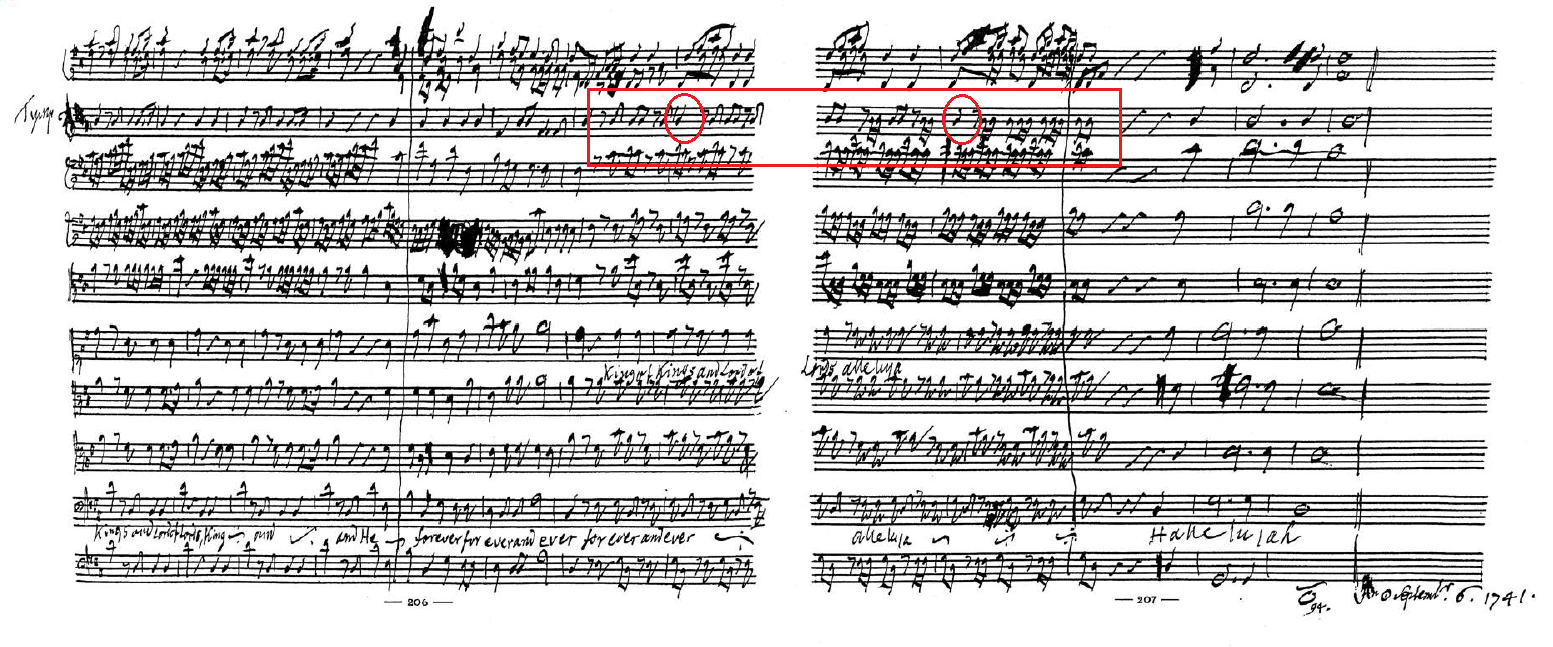
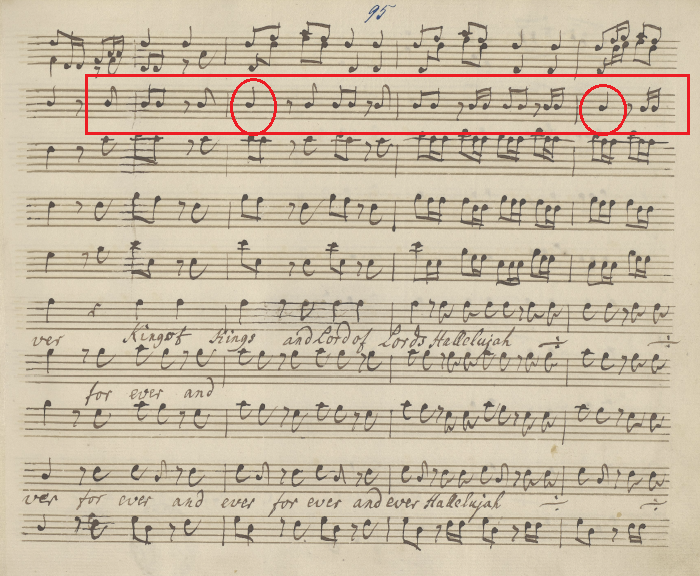
But it does not end here. There is one more suspicious passage that feels weird to me. Marked with a rectangle, it features a couple of “offending” quarter-notes (marked with a circle).
We have been, for the whole number, not only doubling the trumpets, but also the choir and the figured bass. We have “sang”, together with the voices, “Halellujah”, emphasizing with our playing the stressed syllable “-llu-” and playing softer the syllable “-jah”. In this passage we are reinforcing the text “for ever and ever”. As before, the interpretation is to play stronger the stressed syllable “e-” and softer the following “-ver”. We, indeed, do that, but those two quarter-notes interrupt the prosodic rhythm, making us not play the weaker “-ver”. Why do we play that weak syllable sometimes yes and sometimes not if the choir, the trumpets and the figured bass play exactly the same thing in two identical phrases? That does not work to me, as it is not consistent with the text and the rest of the orchestration. We always played the weak syllable in “Halellujah”, but not in “ever”. That, to me, is a clear mistake, so I went back to the manuscripts. This is the 1743/46 one:
Nope… Two quarter-notes again. Let´s check the 1759/63 manuscript:
No luck. The same two quarter-notes but, because it is my opinion that the timpani should double the word “ever” together with the choir, the trumpets and the figured bass, I still believe that this is a mistake, so my edition “converts” those quarter-notes into two eighth-notes.
We already have a precedent of a discrepancy in the manuscripts, so we may be in the presence of a “misprint” that has been perpetuated (thus also in the subsequent editions based on them). I am not afraid of modifying what I belive is a mistake if by doing so I am being consistent with the rest of the instruments and I “improve” the part (to an attentive listener, not doubling the choir and the trumpets is clearly perceived as a mistake. I, anyway, perceive it as such!).
Regarding the endings, it was customary at that time to embellish them with cadenzas. I have written some, using anapest rhythms on the last part of the bar (short-short-long) as they help to create the feeling of a ritardando (as opposed to the long-short-short dactil rhythms, which are very “driving” and move forward). I encourage you to write or improvise your own cadenzas.
Bare in mind that the interpretation markings may not work depending on the conductor´s approach or what our colleagues in the trumpet section do. Be flexible and adapt to the always-changing musical situation.
You can donwload a pdf file with my edition following the link below: