
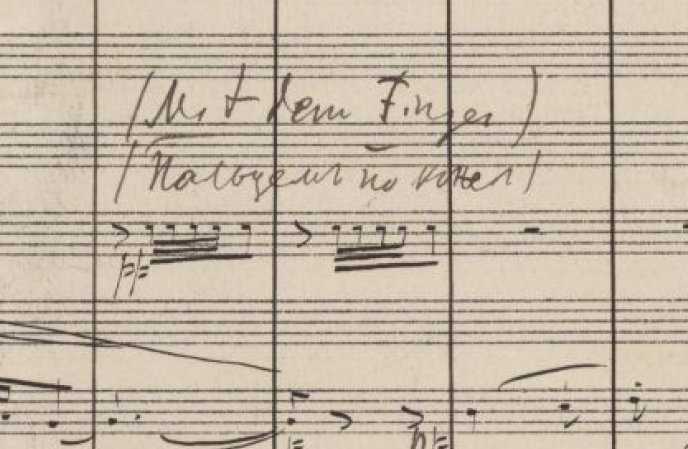
Tchaikovsky´s “Arabic Dance” – Articulate or roll? Last December 27 my article on the tambourine part of Tchaikovsky´s “Arabic Dance” (from “The Nutcracker”) was published on the Grover Pro website. You can read it clicking on the banner below: Thank you very much to Svetlana Manakova for helping me to translate the Russian indications. …et… Continue reading Tchaikovsky´s “Arabic Dance” – Articulate or roll?

Tag: blog
Bowings and stickings: “The Miller´s Dance”.

Bowings and stickings: “The Miller´s Dance” Last November 16, Grover PRO published a video on which I stablish a relationship between the bow strokes on the string instruments and the stickings on the snare drum. I am using Falla´s “The Miller´s Dance” (from “The Three Cornered Hat”) to show what I do to phrase… Continue reading Bowings and stickings: “The Miller´s Dance”.
Restauration of a Givernau tenor drum.

Restauration of a Givernau tenor drum. I have found a very peculiar drum in an antiques fair. It measures 44,7x31cm or 17″ 10/16 x 12″ 4/16). They are not “exact” measures in neither system, which is quite bizarre. It also features some nice single point lugs and the tension rods are off-set. As you can… Continue reading Restauration of a Givernau tenor drum.
“Histoire du Soldat”, what about the “L´”?

“Histoire du Soldat”, what about the “L´”? “Histoire du Soldat”, by Igor Stravinsky, is one of the most important works in the percussion repertoire, as it was one of the first to be written for a percussion set. Apart from its “percusive” importance, it is a masterwork which is played very often (whether staged or… Continue reading “Histoire du Soldat”, what about the “L´”?
Herd bells in “Tosca”.

Herd bells in “Tosca”. I have been to Rome lately, where I have spent some wonderfull days together with my family. Among many other places of general and musical interest, I have been to the Castel Sant´Angelo. The third act of “Tosca” takes place at this impresive building. More precisely at the upper platform. LA… Continue reading Herd bells in “Tosca”.
How I made some snare gates

How I made some snare gates. A snare gate is an opening in the lower counterhoop that allows for the snares to pass through it and to make contact with the resonant head. See the opening in the lower counterhoop, right below the snare strainer. © Grover Pro Percussion View from below. Check the snares… Continue reading How I made some snare gates
“Lieutenant Kije” and a peculiar tambourine technique

Lieutenant Kijé and a peculiar tambourine technique. On January 2, a new article of mine was published on the Grover Pro Percussion website. © Grover Pro Percussion Dealing with the very specific tambourine technique requested by Prokofiev in “Troika”, you can read it HERE. Tambourine part in “Troika”. …et in Arcadia ego. ©… Continue reading “Lieutenant Kije” and a peculiar tambourine technique
Modification of a Premier bass drum

Modification of a Premier bass drum. This project is a consequence of a larger one; namely, to provide myself with the proper drums to recreate as close as possible the original sound, character and looks in Stravinsky´s “The Soldier´s Tale”. For the bass drum I used a 28″x12″ Premier (model 188) from the 70s.… Continue reading Modification of a Premier bass drum
Xylophone in Richard Strauss´ “Salome”

Xylophone in Richard Strauss´ “Salome”. We, percussionists, very often play on instruments that, in reality, are not those that the composer indicated. We have the keyboard xylophone in “Bluebeard“ (B. Bartok), a part impossible to play on a regular xylophone; the glockenspiel parts in many works (“Magic Flute”, Mahler #7, «Daphnis et Chloe», etc.), which… Continue reading Xylophone in Richard Strauss´ “Salome”
“Concerto for percussion and small orchestra” (D. Milhaud)

“Concerto for Percussion and Small Orchestra” (D. Milhaud) Considered one of the first concerti for multipercussion, the Concerto pour batterie et petit orchestre op. 109, by Darius Milhaud, was written between 1929 and 1930. An important work in the percussion repertoire, it is played very often by both students and professionals. It is scored… Continue reading “Concerto for percussion and small orchestra” (D. Milhaud)