David Valdés

Timpani in "Falstaff" (G. Verdi)

Since the last couple of weeks I am in Valladolid playing a wonderful production of “Falstaff” (G. Verdi) together with the Orquesta Sinfónica de Castilla y León under the baton of Óliver Díaz.


As you already know, the timpani parts in Italian opera are often discussed because the “alien” notes to harmony that they contain. It is for that reason that you can find my own edition  HERE.

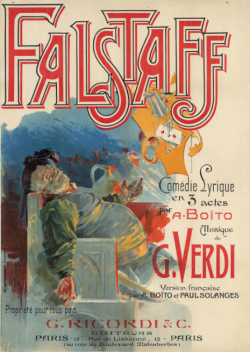
cartel

At the time that “Falstaff” was written (1889), rotary and pedal timpani were already common; futhermore, the use of at least three drums made changing pitches a normal and easy task.


In 1842 “Manuale pel timpanista”, by Carlo Antonio Boracchi, was published. The author suggests that “wrong notes” were changed to fit the harmonic context. A little later, in 1849, Ernst Pfundt published “Die Pauken”, where he undoubtly states that changing “wrong notes” was a regular practice.


I was lucky to get lessons from David Searcy, timpanist at La Scala (thus a “heir” of Boracchi´s tradition) and a scholar of the Italian tradition. He taught me that timpanists of that period regularly changed notes so that they could fit the harmony. I have also got confimation regarding this issue from Riccardo Muti during a conversation when he visited Oviedo in July 2015 to conduct, coincidentally, “Falstaff” at the Teatro Campoamor.


Neglecting the evident, that known by timpanists and composers and that is part of the interpretative tradition, is denying what European performers have done in a regular and usual way during the 19th-century. Let us be open-minded, accept the evidences and play using logic and musical sense.


Because this article is not an in-depth analysis (something that, in the other hand, any one can do opening the conductor´s score), I will only comment a few examples to ilustrate my edition. Of course, there could be as many editions as timpanists playing this opera, exactly the same as if we were “orchestrating” a banda turca part: there are as many options as there are interpreters, a characteristic of Italian opera from the ottocento


I strongly encourage you to read the above mentiond books, and also the splendid “The Timpani and Percussion Instruments in 19th-century Italy”, by Renato Meuci, already mentioned HERE.

It is quite common for the timpani to not literally double the bass parts and, instead, use another note of the chord, normally the seventh. For many, that is part of the character and sound of the Romantic orchestration. When this happens, I left the part as is.


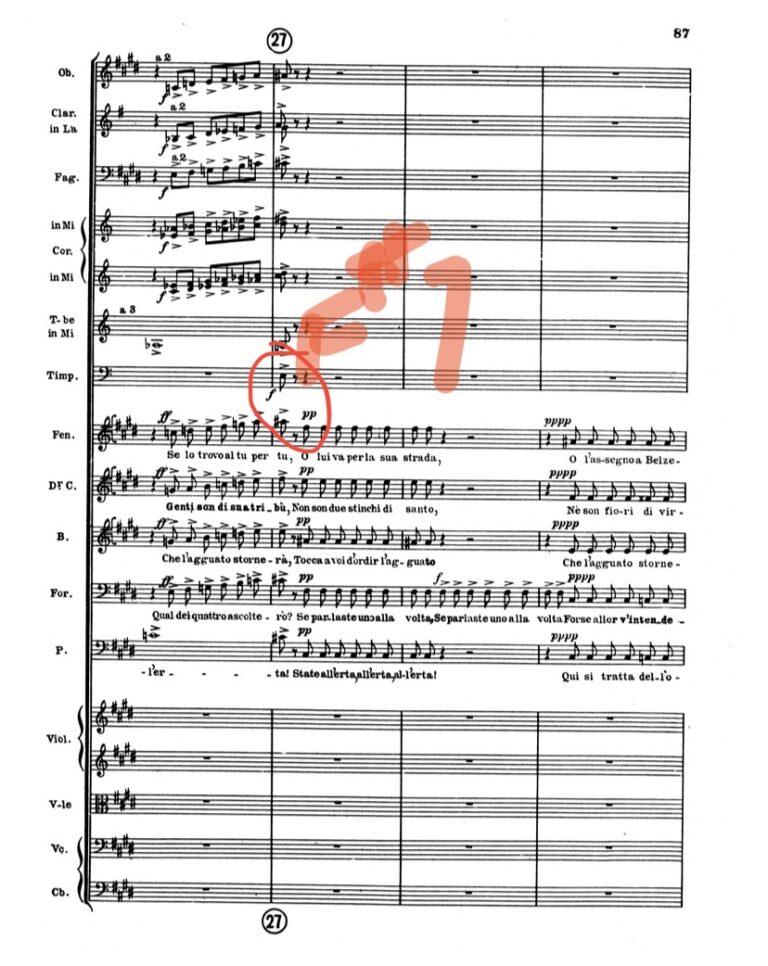
Here we can see a F# major chord plus a 7th where we play an E, which is part of the chord, so I play it as is.

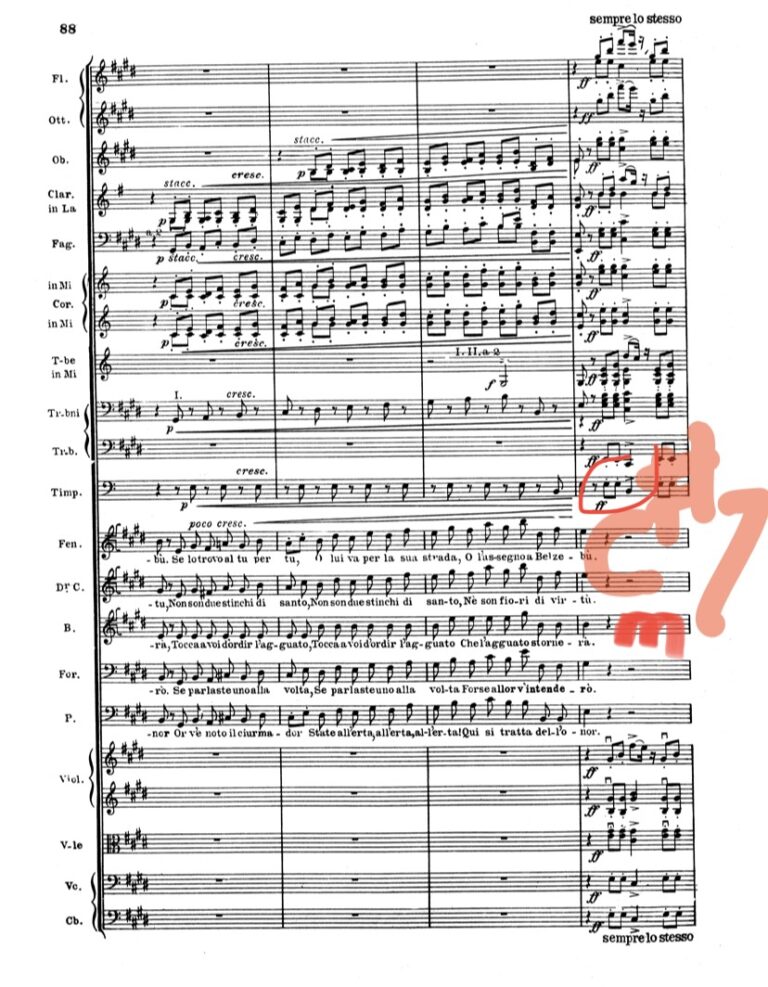
A similar case here. The harmonic context is C# minor plus 7th. The timpani do not double literaly the bass voices (E-C#), but E and B. Because both pitches fit the harmony, I let them be.

When the pitch is not part of the harmony, it is a good time to start editing.


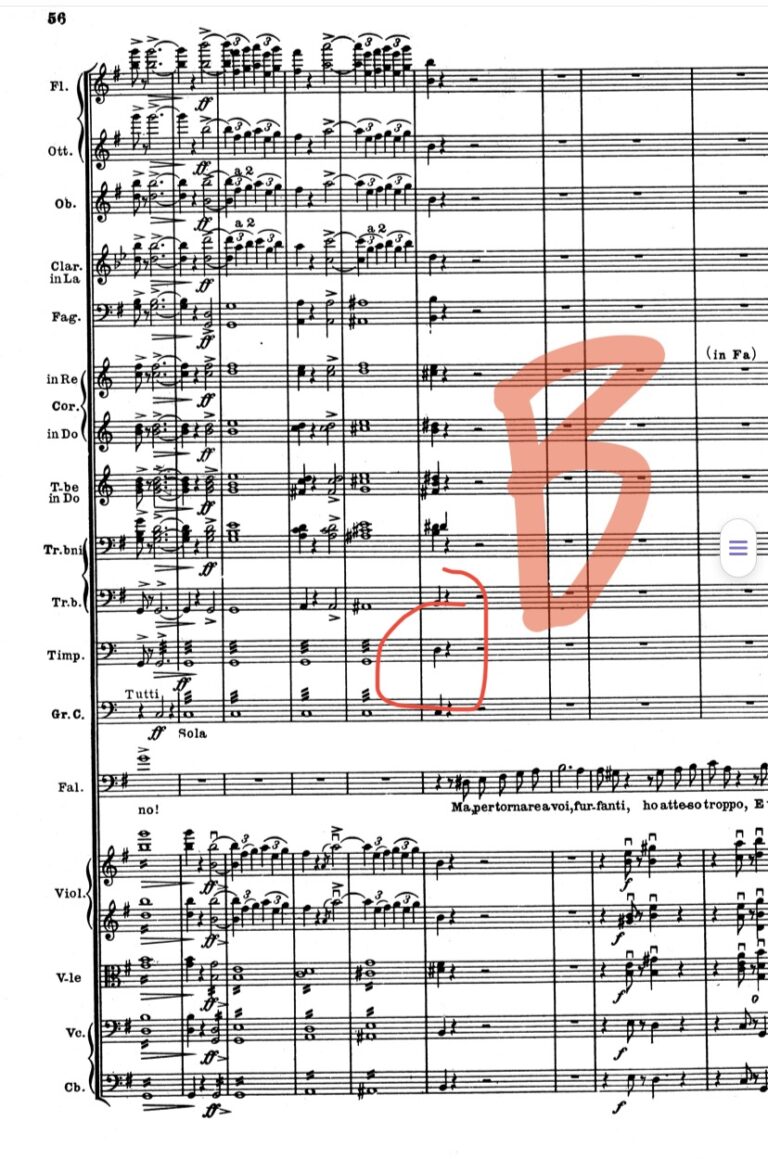
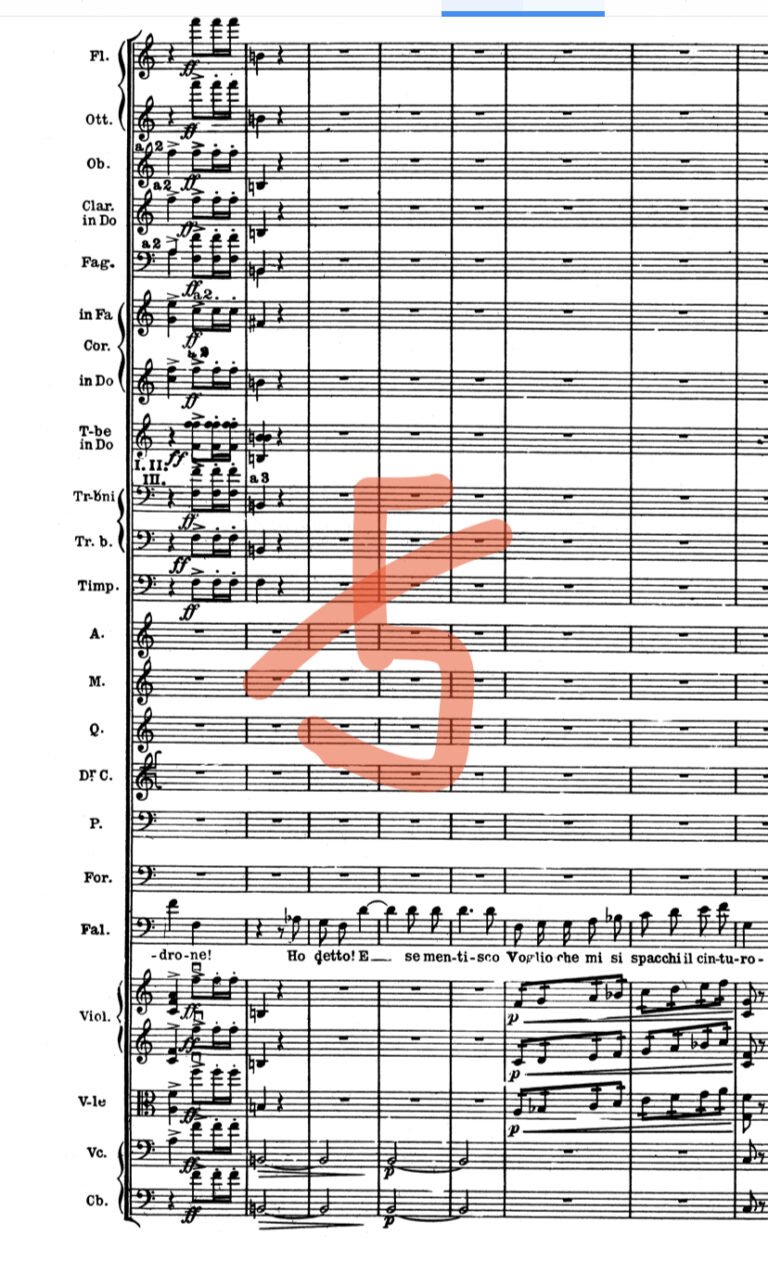
After the roll, the timpani plays a D natural, but the harmony is B major. Obviously, that D natural clashes with the D# in the chord, resulting in an out-of-place dissonance. I could play either D# or B natural but, as the fourth trombone (“Falstaff” is scored for four trombones, not 3+cymbasso/tuba), I prefer B natural.

Sometimes, the orchestra plays perfect unisons. If the timpani are the only voice not playing it, the effect is destroyed.


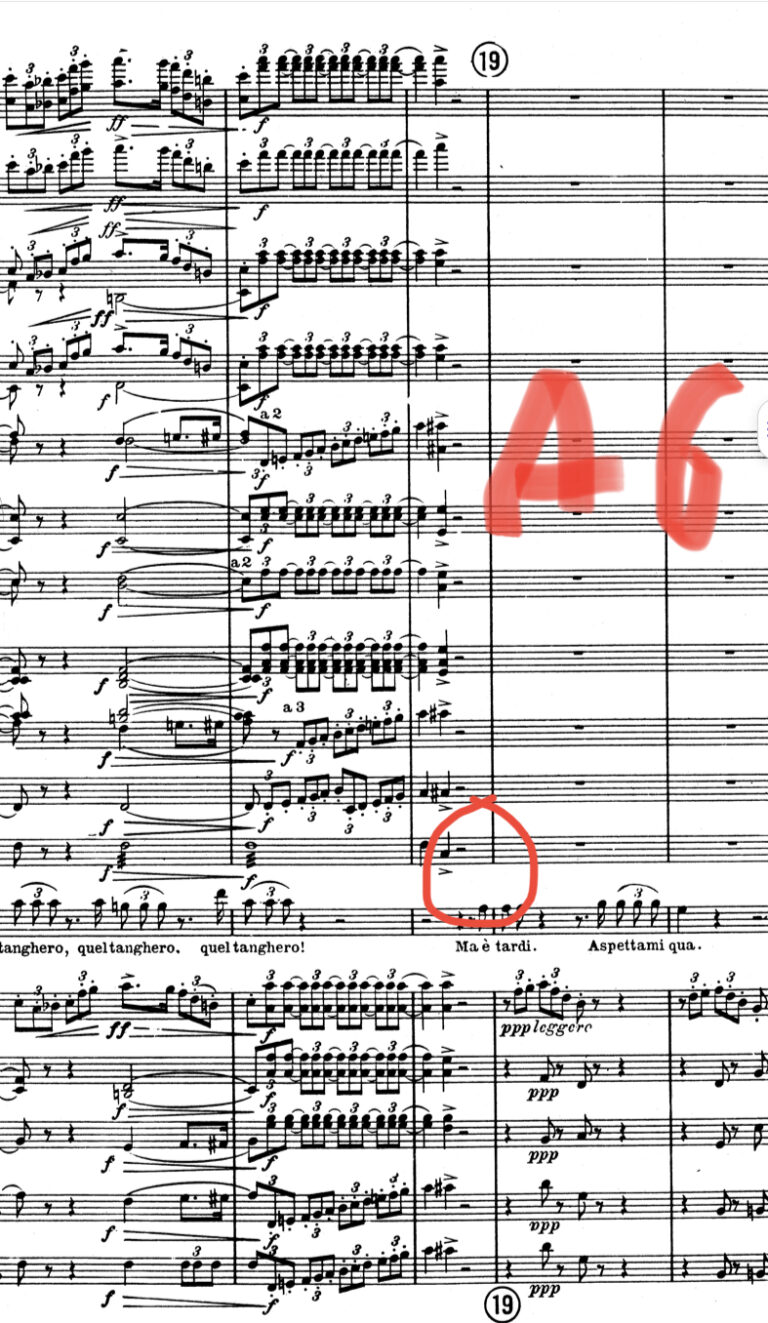
Here, the full orchestra is moving using an interesting descending diminished-fifth interval. If I play the final F natural, the effect does not work, so I edit and play a B natural together with the rest of the instruments.

A similar case happens here, where the resolution of the low-voices is on a C#, an A major chord in first inversion. The part indicates C natural, which produces an out-of-place dissonance, so I edit and play a C#.

But editing is not only about changing pitches. It is also about changing articulations, lenghts, etc.


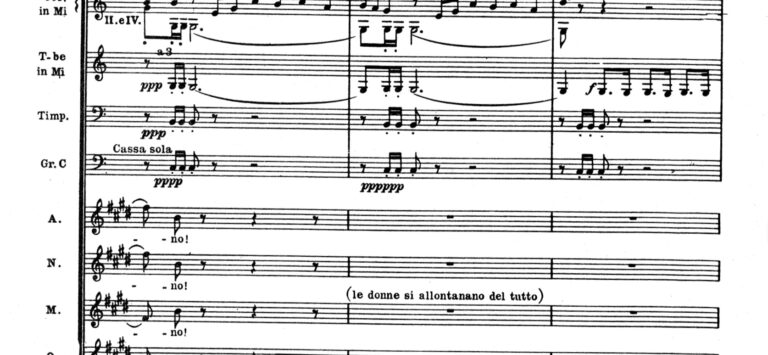
In the following passage we have been playing stacatto and short for already several bars. Suddenly, the character changes and the trumpets play their last note long. In my edition, the first two bars are modified to match the phrasing and length of the trumpets. The third bar is, again short, so the “trumpet call” gets a clean entrance.


These three bars are also played by the bass drum. Obviously, if I am editing the timpani part, it is of vital importance to discuss it whith my collague playing the bass drum so we both play exactly the same on both instruments.

There are many examples like the ones above in my edition. You just have to check it with the conductor´s score to see my criteria when editing.


I know that this may be controversial for some timpanists, who prefer playing the ink not matter what. Another way of thinking, closer to the historical practice, sees this normal, necessary and musical.


Which group are you in? 😉


…et in Arcadia ego.

© David Valdés