If you have played French repertoire, chances of you having found the indication “mailloche” are very high. Altough the actual tendency is to not use a great variety of sticks on the bass drum, it is good to know what a mailloche is to enrich our tool arsenal, thus our expressive, timbrical and musical possibilities.
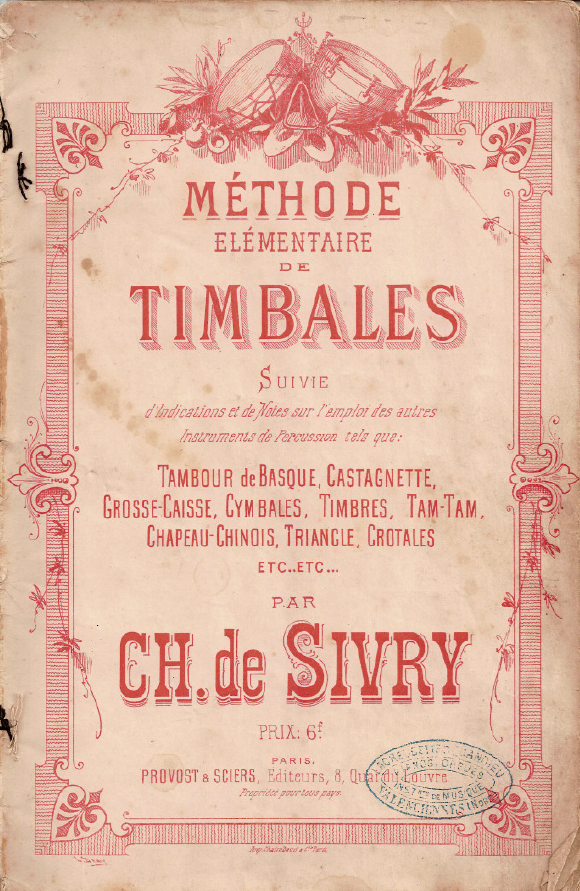
As always, there is nothing better than checking the old manuals and teatrises. Let us have a look at Charles de Sivry´s Méthode Elémentaire de Timbales:
Should you want to know more about this author, you will see that information is very scarce. The previous link to Wikipedia is the best that I could find; apart from that, nothing but shadows.
Regarding the book, it does not feature a publication or copyright date, but the preface is dated by Sivry in Paris on May, 1880. I cannot remember where I got my copy, and searches on the internet provide ZERO results. It seems like I own a very rare specimen.
A good thing about this little book (it is only 20 pages long) is that it includes information about other percussion instruments (snare drum, bass drum, cymbals, tambourine, castanets, xylophone, Provenzal drum, triangle, whip, sleighbells, tam-tam, canon, Turkish crescent, and sistrum). Obviously, with so many instruments condensed in only twenty pages, not much information can be provided, but it is quite interesting, nonetheless.
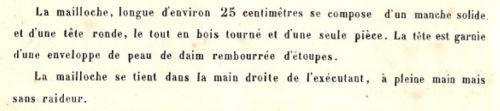
On chapter 26, devoted to the bass drum, we can find a very precise description of a mailloche:
The mallet, about 25 centimeters long, consists of a solid handle and a round head, all made of turned wood from a single piece. The head is covered with a deerskin sheath stuffed with tow.
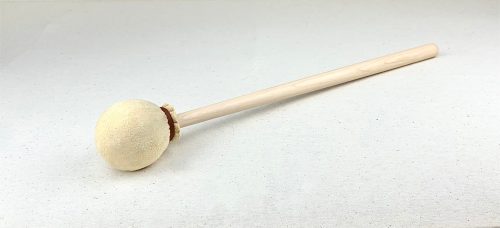
That “deerskin” reffers, quite obviously, to “chamois” (rupicapra rupicapra). When I was researching the sticks that Stravinsky requested in “Histoire du Soldat”, I was able to make a mailloche identical to that described by Sivry:
The handle, made of hickory, is slightly tapered down to the point, the ball also made of wood. I make two versions; one covered only with chamois (clear atack, more impact sound), another one covered with both chamois and duffel (a more cushioned attack and a fuller sound).
They provide a timbre and character perfect for the 19th-century repertoire, when the bass drums were smaller, featured natural skin heads and they were still heavily influenced, both in terms of sound and technique, by the davul.
See that it was the kind of stick used at Rossini´s time.
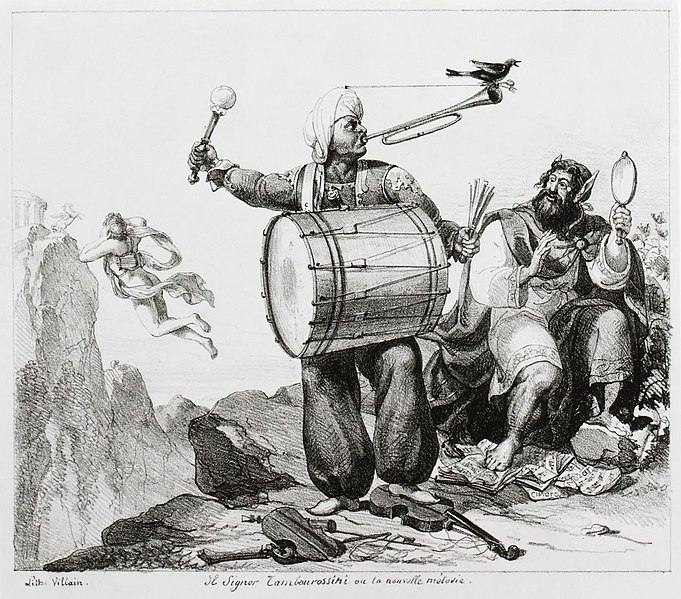
On the cartoon above, criticising the excesive use of percussion, we can clearly see a mailloche in the performer´s right hand, while he is holding a rute in his left one (as it was customary).
The mailloche is a stick very much needed in a complete palette. Should you want one (or a pair), I can make it for you. Please visit THIS LINK.