
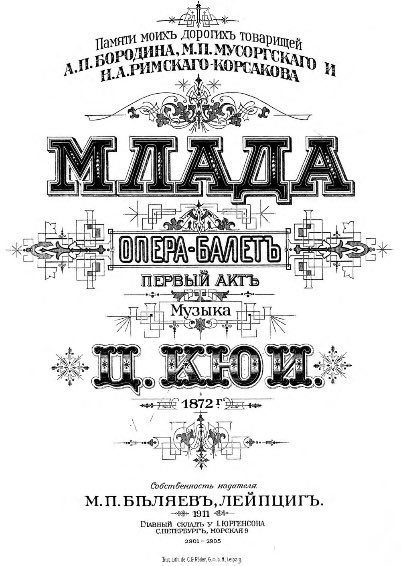
«Mlada» is an opera-ballet by Rimsky-Korsakov written between 1899 and 1890 and premiered in 1892. It is hardly played nowadays, but the composer converted the third act into a tone poem named “A Night on Mount Triglav” which, again, is hardly played, but it is performed slightly more often (just very slightly) that the work that it was extracted from (“Procession of the Nobles” is the most well-known part of “Mlada”).
The timpani part includes something very unusual; namely, a “petit timbale” tuned to a high Db (note the indication 8ª -it is written using an alto clef in the opera-). That is a very high note for a regular-size drum, so a smaller instrument is needed to play in such an extreme register.
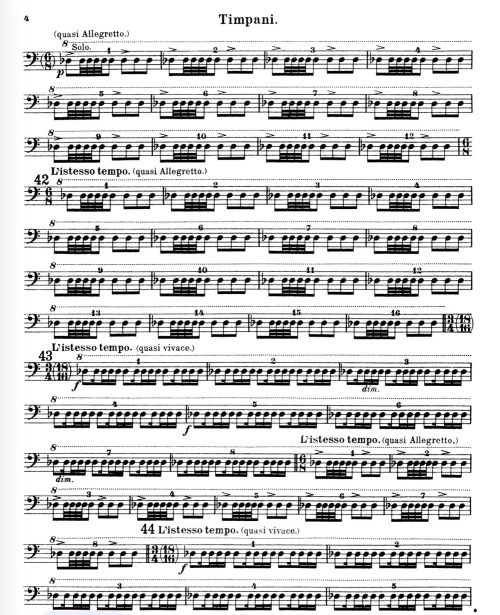
That writing inmediately reminds us of the snare drum part in the third movement of “Scheherezade” (specially at figure 42, where we are accompaning a melody of evident Oriental flavor by the oboe and the flute, which features EXACTLY the same two-note pick-up). That is not a coincidence, as “Scheherezade” was premiered in 1888, exactly one year before “Mlada”.
Korsakov did not write this part at random or using an esoteric instrument available only at a specific theatre (as it was the case, for instance, with the keyboard xylophone in Bartok´s “Bluebeard´s Castle”). Rimsky had a “petit timbale” specially made for him, this way ensuring that “Mlada” would be played using the correct instrument anywhere. This is documented in his own “Treatise of Orchestration”:
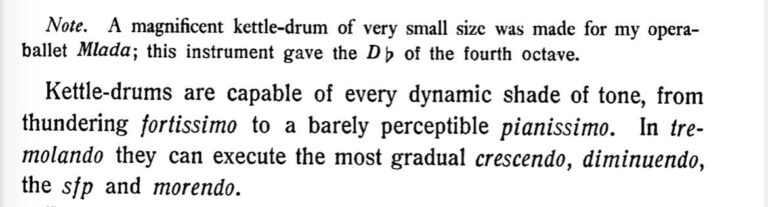
When dealing with the range of timpani, he included the note above. First-hand information; the composer himself explaining the origin of this instrument.
To start getting into the plot thread of this article, we must know that Fiódor Stravinsky (father of Igor) sang the main role in the premiere of “Mlada” (Mstivoy). Here he is in a promotional photo:
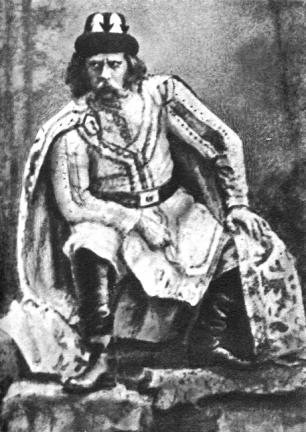
Fiódor Stravinsky died in 1902, the same year in which his son first visited Rimsky-Korsakov in Heidelberg to show him some of his compositions. Since that year, and fed up with his Law studies, he began studying composition with the maestro until 1908, when Korsakov died (he studied more assiduously with him since 1905).
Rimsky was not alien to the domestic life of the Stravinskys (and vice versa), as it is known that Fiódor premiered many of the opera roles by Korsakov, so the composer-to-be was already familiar with the veteran master.
Because both families shared excellent relationships, there was a stronger bond between Korsakov and Stravinsky than the mere teacher/student one; it was a father/son mentorship, in which Rimsky was a father figure, as Stravinsky lost his at 20. It was a relationship of mutual respect and very familiar. Stravinsky even wrote a cantata to celebrate the 60th anniversary of Korsakov, which was premiered at the latter´s house.
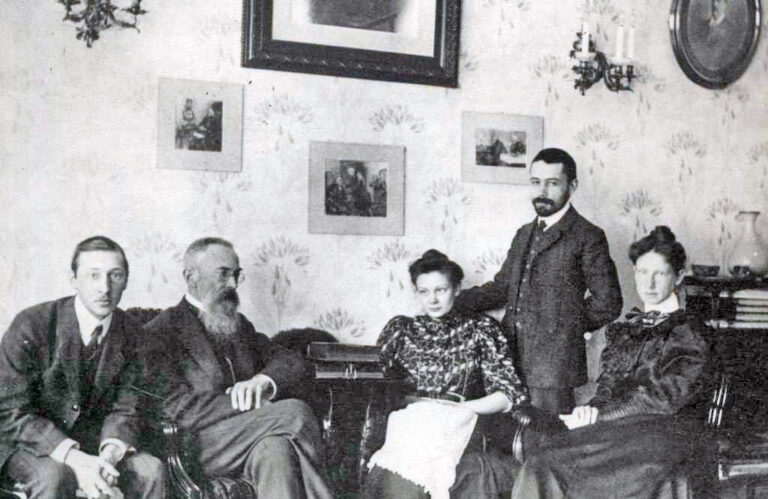
Now we are entering swampy terrain, as many of my proposals are mere speculation (“I have no doubt but neither proof”). Much of what follows is circumstantial and does not allow me to 100% affirm that what I say is true, but everything seems to fit.
Here it goes. I firmly believe that, due to the excellent relationship between Stravinsky and Korsakov, the latter presented his student the “petit timbale” that the had specifically made for “Mlada”.
Stravinsky travelled outside Russia for the first time in 1910 for the premiere of “The Firebird”. He kept his residence in Saint Peterburg (and his much-loved summer house in Ustilug), but the premieres of “Petrouschka” and “The Rite of Spring” made him to constantly travel around Europe. In June 1914, intuiting the outbreak of WWI, he travelled to Ustilug in an effort to retrieve as many personal effects, documents and scores as he possibly could. Maybe, this was the occasion in which the “petit timbale” given by Korsakov left Russia (maybe it left the country before to be used in the premiere of “Le Sacre”). He then moved to neutral Switzerland, which he already knew, as his wife stayed there in a sanatorium to cure her tuberculosis.
He lived in Clarens y Morgues between 1914 and 1920. It was in the latter that he wrote «Histoire du Soldat». At that time, Stravinsky already owned a considerable amount of percussion instruments. In 1915 he already owned a cimbalom, which he used to write “Renard”. Charles-Ferdinand Ramuz (libretist of Histoire) states that the blue room in the maison Bornard overlooking the garden was crowded with percussion instruments, and he specifically mentions a timpano (“Souvenirs sur Igor Stravinsky”). Stravinsky also bought some more percussion at a store in Lausanne («Expositions and Developments”, by Robert Craft) and he spent more time practicing on them than composing (“Retrospectives and Conclusions”, also by Robert Craft). In fact, he owned quality instruments, as Ansermet (the conductor in charge of premiering Histoire), asked Stravinsky to bring his own bass drum and cymbal to the rehearsals, as those provided in the first place were of inferior quality (“Stravinsky in Pictures and Documents”, by Robert Craft). By the end of his Swiss years, Stravinsky owned a large collection of percussion instruments (“Expositions and Developments”).
The 1917 Bolshevik Revolution was an impediment for him to return to Russia after the war (he only made a very short trip to the then USSR in 1962 to commemorate his 80th anniversary). Because of that, he moved to France in 1920 (he stumbled across the country before finally settling in Paris. Believe or not, Coco Chanel makes an appearance at this point). It is at this very precise time that we can find irrefutable evidence proving that Stravinsky owned a “petit timbale”. For moving from Morges to Paris, he hired the Genevan company Sauvin (which stills exists. I have even contacted them asking for information), which is confirmed in «Stravinsky in the Twenties» and in «Stravinsky in Pictures and Documents», both by Craft). As his only complain was that his bycicle was missing, we can assume that his percussion instruments arrived safely in France.
Yes. In early April, 1921, the Pleyel company gave Stravinsky studio space at 24 Rue de Rochechouart (adjacent to the historical Salle Pleyel, today in Faubourg Saint-Honoré), where his percussion instruments where installed. Some of them can be seen in photos taken by Vera de Bosset (Stravinsky´s maid and future wife. It was this love triangle that made settling in France quite hard, as the composer did not want his family and his lover to meet; his family stayed in Biarritz while he was living in Paris, above the piano workshop -note how far apart the two cities are-). Not much of interest: a triangle, a snare drum a cymbal…. It is not until 1929 that a proper photo session took place at the Pleyel studio, Boris Lipnitzki at the helm. Now, yes!, we can see many of the percussion instruments belonging to Stravinsky (some of them were used while he was composing Histoire; maybe, they were even used on the premiere night. Please check my critical edtion). Here they are:
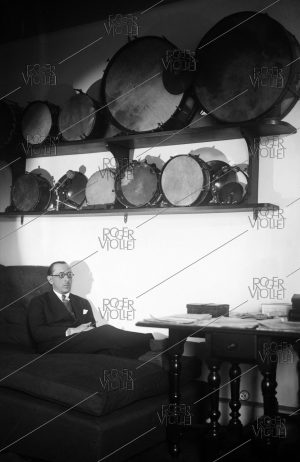
I have kept a low resolution and the watermark because of copyright issues and because I had to pay a nice sum of money to use this specific photo in my critical edition of “Histoire du Soldat”. You can see it at full resolution in my book.
The instrument on the upper shelf, third from the left, is, clearly, a timpano of small size:
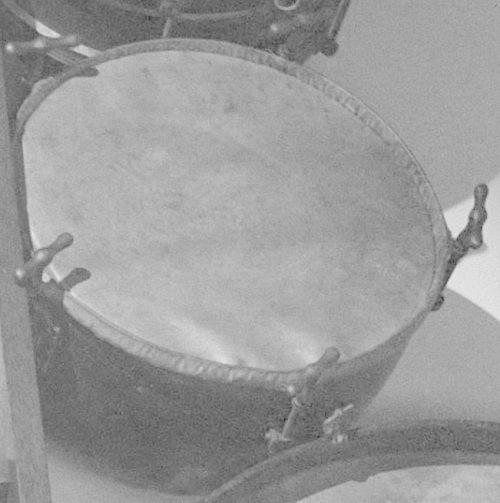
Note the tap-shaped tension rods (five of them), the head lapped onto the counterhoop, the shape of the bowl and its very small size (check the snare drum to its left; that timpano was not more than 14″. Check now the bass drum to its right, clearly much larger). If we add to that that only one timpano is present (and we know that they are used in pairs), its “singularity” is reinforced, it being made for that specific passage in “Mlada”, and not as part of a set of two to play the usual tonic and dominant.
Rimsky -Korsakov only used the “petit timbale” in “Mlada”. Did Stravinsky use it on any of his works? Yes, indeed. He scored for it in “The Rite of Spring”, where he writes a B natural in «Jeu du rapt», «Jeu des cités rivales», «Évocation des ancêtres» and «Danse sacrale» (B flat). Also, the time frame for the Rite and Korsakov´s death (1908) is very close. Not to mention that “Mlada” and “The Rite” both share a common pagan theme (Slavic in the case of the former, Russian in the case of the latter). To me, that both works share a common theme and that both works feature a “petit timbale” would prove that Stravinsy used (or at leat was inspired by it during the composition process) the instrument that his teacher and mentor would have given to him. Also, it would not have been the first time that Stravinsky would have given up his instruments; maybe the “petit timbale” for the rehearsals and premiere of “La Sacre”?, maybe the bass drum and cymbal as requested by Ansermet for the rehearsals and premiere of “Histoire”?, maybe the cimbalom for “Renard”? Nothing for sure, only guesses.
Stravinsky also wrote a B flat in “Agon”, but that work was already written in the U.S.A. Note that all the works in which Stravinsky requested a “petit timbale” were ballets, and we have to remember that Korsakov´s “Mlada” was also a ballet.
Stravinsky emigrated into the U.S.A. in 1939, just few weeks before the outbreak of WWII (it seems that he was good at predicting international conflicts) but, this time, his luggage was much lighter; he entrusted his percussion instruments to his niece Ira Belline (Irina Grigorievna Beliankina). She emigrated to Tangier at an undetermined time (none of the books that I have read specifies when, and internet searches provide almost no results, but she probably fled Paris at the beginning of the war). Unfortunately, and this is documented by Robert Craft, those instruments have been missing since 1945 (“Stravinsky in Pictures and Documents”). Therefore, I am afraid, we will never be 100% sure about this fascinating issue.
Summarizing: whether while Korsakov was still alive, whether as a present from his family after he died, the “petit timbale” in “Mlada” was given to Stravinsky. In 1920, that timpano arrives in Paris (after the exile years in Switzerland) together with the rest of the instruments in Stravinsky´s collection. Irrefutable graphic records exist from 1929 proving that Stravinsky owned, indeed, a very smal-sized timpano, kept at the Pleyel studio. In 1939 he emigrates to the U.S.A., entrusting all his percussion instruments to his niece and, in 1945, they are lost without a trace.
What do you think?, could the “petit timbale” that Stravinsky undoubtedly kept at the Pleyel studio in Paris be the one that Rimsky-Korsakov had built for “Mlada”? I would love to think that yes, but we will never get to a definitive answer (whether an affirmative or a negative one) as, I am afraid, these instruments are long lost. Nothing but assumptions.
Please stay tuned, as I will record this part using my soprano timpani.
…et in Arcadia ego.
© David Valdés
