Last week I wrote THIS article. While researching on another issue which I will write about soon, I found more music that proves my previous article; namely, that “+” means suspended cymbal played with a soft stick and “o” means cymbals “a 2”.
Rimsky-Korsakov wrote the opera-ballet “Mlada”. Its third act was converted into a sort of symphonic poem titled “A Night on mount Triglav”. The score contains loads of useful information:
"Mlada". Indications in the conductor´s score. Public domain.
Observation I. Le signe |-| dans la partie des Piatti indique un coup avec une baguette molle (Colla bacchetta da Timpano); le signe o un coup sur les cymbales.
“Observation I. The symbol |-| in the cymbal part indicates a stroke with a soft stick (Colla bacchetta da Timpano); the symbol o cymbals stroke”.
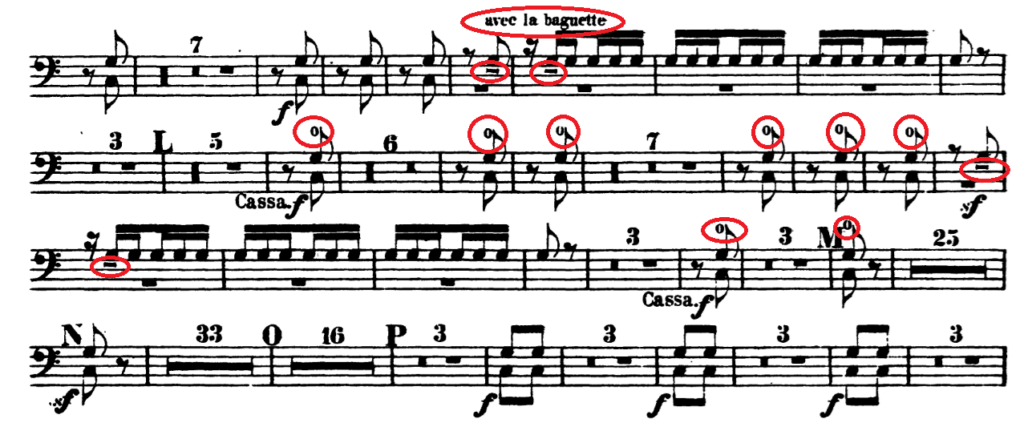
Excerpt from "Mlada". The symbol "o" appears in the third and fourth bars, meaning cymbals "a 2". Public domain.
This opera-ballet was composed between 1889 and 1990, exactly the same period in which Glazunov wrote “La mer” (1889). There is a slight graphic difference between “|-|” and “+”, but it is just an editorial/engraving thing. In both cases “o” means cymbals “a 2”.
Excerpt from "Mlada". See the symbol for the suspended cymbal together with the indication "colla baqueta". Public domain.
Excerpt from "Mlada". The "o" indicates cymbals "a 2". Public domain.
Excerpt from "Mlada". The symbol (together with "colla bachetta") indicates suspended cymbal. Public domain.
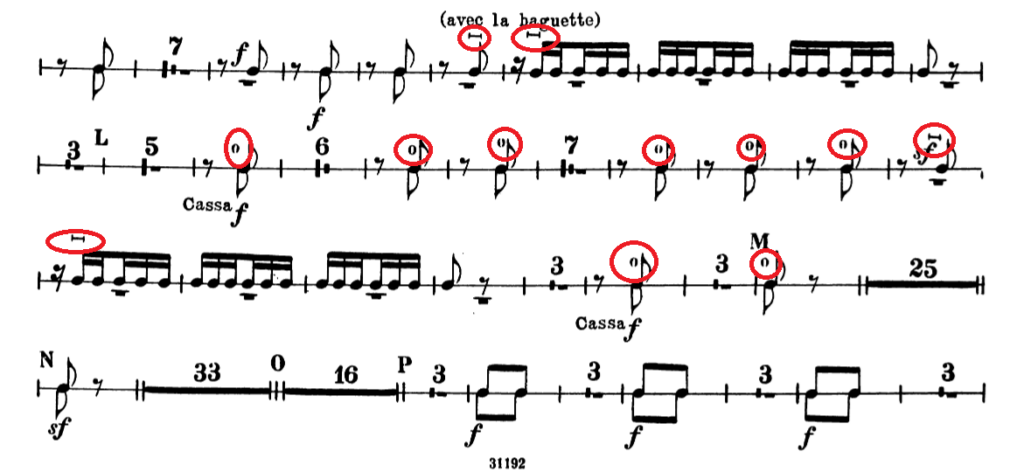
Not only that. The uber-famous “Scheherezade” also uses this notation 😉. See the passage on suspended cymbal (traditionally played by the snare drummer) in the fourth movement, where both symbols can be clearly seen:
"Scheherezade". Fourth movement. Cymbal part. M. P. Belaieff. Leipzig, 1889. Public domain.
"Scheherezade". Fourth movement. Cymbal part. Muzgiz. Moscow, 1964. Public domain.
All this confirms what has already been stated in my previous article. The meaning of that notation should be now perfectly clear. It is great to see how two geniuses like Glazunov and Rimsky-Korsakov, both teachers at the Saint Petersburg Conservatory, have influenced the next generations of Russian students and composers. Passing this notation to them is part of the normal and deriable relationship between teachers and students.
No more problems when playing the Russian repertoire!! 😉