David Valdés

Chinese cymbals, how should I set them up?

How to set the Chinese cymbals is a question that is asked quite often in groups, forums, etc. I wil try to clarify this issue, but first, let me review their history.
 
Chinese cymbals have been made, literally, for millennia. They were always played in pairs, hitting one against the other.
"Una banda cantonesa". Postal de alrededor de 1910.
A Cantonese band. Postal card circa 1910.
Celebración del Año Nuevo chino. © Baltimore Sun.
Celebrating the Chinese New Year © Baltimore Sun.
Their use varies between the religious and funerary to drive away the bad spirits to a mere festive one. Note that the bell is shaped as a handle to be used as such. Fabric is used to ornate them. 
Platos chinos. © Chineseorchestra.org

You can see them in action in a traditional context in the following video. As you can see, the concave sides are the ones hitting each other, striking on the charasteristic flang present in these cymbals

Chinese inmigrants started arriving into the United States around 1820. They did so, following a pure geographical logic, into the East Coast, being San Francisco their port of arrival. They worked on mines (the Gold Rush in California was at its peak), building the railway from coast to coast and, if we have trust the comics featuring Lucky Luke, they run laundries (I hope you like European comics as much as I do). 
 
Obviously, they brought their traditions, and cymbals were one of them. Already in the first third of the 19th-century, the use of Chinese cymbals is documented to attract people to political rallies. In 1865 the Civil War ended, and the musicians discharged from the army had to make a living in the civil society. At first, there was a a musician for every single instrument (bass drum, snare drum and cymbals, as in the military bands) but, out of necessity (and to save money), a single player started playing more than one instrument at the same time, and double-drumming techniques started to be used. Then, the use of pedals and stands that allowed a single percussionist to play all the instruments simultaneously, started shaping what we now know as the drumkit.
 
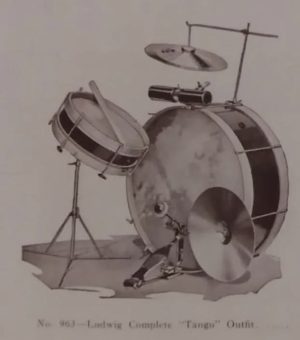
At the beginning of the 20th-century, this is what a drumkit (in fact, that is a trap set) looked like:
8440747
The trend at that moment was to use two cymbals; one Turkish, the other one Chinese (Turkish also migrated into the United States. Avedis III settled in the country in 1908, so both types of cymbals were available).
 
The cymbals were hanged from the rope that they already featured (see photo above) on gooseneck stands (modern stands were still not available). See that, hanging the cymbals as in the photo above, the Chinese cymbals were struck in a completely different zone than the one that they were struck for millennia: the shoulder of their convex side.
trapset

See? When hanging the cymbals to play in this new fashion (in a trap set context) they started to be hit on the opposite side that they were traditionally hit, the bell pointing upwards. This is the only possible position when mounting them on a gooseneck stand. If we mounted them with the bell pointing downwards, the cymbal would not stay horizontal, as the nature of the hanging would make it unstable and unplayable, as it would be tilted. So, all of a sudden, Chinese cymbals passed from being played in pairs, one against each other, to be played suspended, just one and on the opposite, “wrong” side. 

Ludwig Tango outfit
Ludwig "Tango" outfit

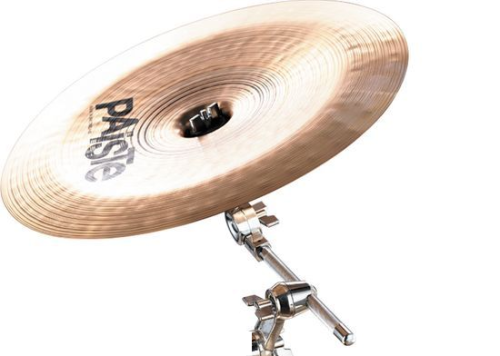
It was not until the advent of modern stands that Chinese cymbals could be set “correctly” and hit on the convex side (the bell pointing down).

modern chinese cymbal
© Paiste

So… How do I set them up? Easy; as you fancy! 😉 It is important to know that these cymbals were, originally played in pairs, one against the other, so the “correct” option would be setting them on the stand with the bell facing down. This way we would strike the concave side, on the flange, where they were conceived to be hit. BUT, when making music, sound and context is paramount. If I like how the cymbal sounds when “up side down” (bell pointing upwards), no body is going to take me to jail, nor it is forbidden nor you will be fined. What if you are playing in a swing band, New Orleans style? If you want to sound authentic, logic dictates to mount it as in a trap set (bell pointing upwards), as it was done 100 years ago, even if that is not how Chinese cymbals were traditionally played. Context and sound. Let them be the judges.


Just one thing. Our sticks may suffer when the cymbal is mounted “trap set style”, as we may hit the edge. Having said that, we should strive for sound, character and style, no matter how, and our modern stands allow us to mount the cymbal in many ways, so let us do it in the most musical way that produces the sound that we are after. It is that simple 😉.


…et in Arcadia ego.

© David Valdés