David Valdés

"Bluebeard´s Castle" - Xylophone

This month, the Asturias Symphony Orchestra is playing Béla Bartók´s opera “Bluebeard´s Castle”. This work features one of the most unusual and difficult xylophone parts in the repertoire, and this article will deal with this particular issue.
"Barbe Bleue". Ilustación de Gustav Doré para "Les Contes de Perrault". Paris, Jules Hetzel, 1862. Pag. 56
"Barbe Bleue". Ilustration by Gustav Doré for "Les Contes de Perrault". Paris, Jules Hetzel, 1862. Pag. 56
The opera starts with a spoken introduccion which leads to seven scenes corresponding to seven rooms. Judith, Bluebeard´s wife, is free to wander through the castle, but she is not allowed to enter one particular room. Moved by curiosity, she cannot help but to enter every room. When she gets to the forbidden one, she opens the door, which means her condemn…
 
Bartok knew the xylophone very well, as he used it on “The Miraculous Mandarin”, “The Wooden Prince”, “Music for Strings, Celeste and Percussion”, “Sonata fo Two Pianos and Percussion”, etc. But, as Bartók was heavily influenced by popular music (we know him as a pioneer on Ethnomusicology), the instrument he associated with the xylophone was the at that time already dated “Strohfidel”.
Xilófono de cuatro filas. © Lefima
Four-row xylophone. © Lefima
The picture above shows a “Strohfidel” (a “straw fiddle”, because the bars layed on strips of straw instead of on a frame with resonators). This is the instrument that Bartók was familiar with (and also Richard Strauss, as that is how he literally names the instrument in several of his works), as it is omnipresent in Hungarian folk music, and it´s closely related to (also from a technical/interpretative point of view) the cymbalon, very popular in Hungary as well (this instrument coming from the Persian santur). Bartók knew this instrument so well that when the “Sonata for Two Pianos and Percussion” was first rehearsed, Saul Goodman (legendary timpanist for the New York Philharmonic and one of the musicians playing the premiere) was asked by the composer to remove the resonators from his “modern” instrument in order to better suit the sound of the “Strohfidel”.
 
Now we know the “Strohfidel”, but that was not the instrument that Bartók scored for in “Bluebeard´s Castle”. Before going on, I must show you the part so you can see those infernal passages:
Parte de xilófono de teclado. © Béla Bartók
Passage in octaves © Béla Bartók
Acordes placados de tres notas. © Béla Bartók
Three-note chords. © Béla Bartók
You can listen to the first fragment from 15:50 on and the second one from 37:52 on. 

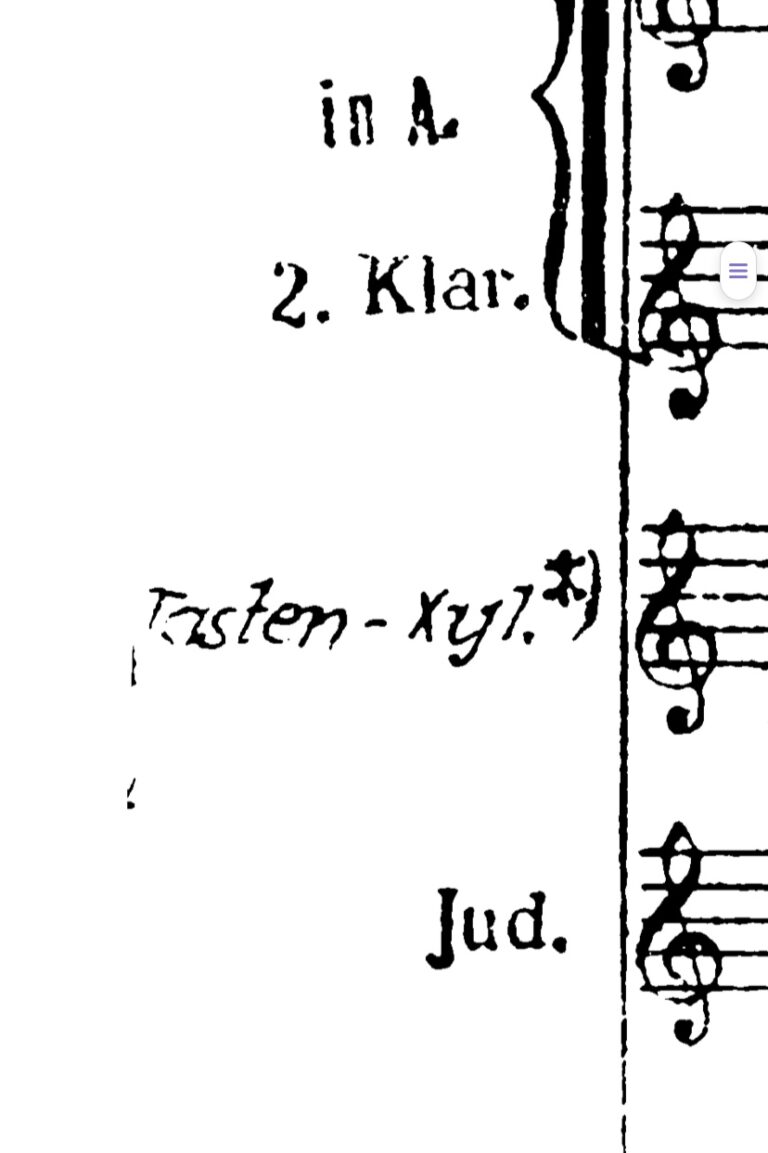
We can hear that all the lines in the first passage are doubled in octaves. That is the first clue. The second one is the three-note chords in the second excerpt. All that is very idiomatic on a piano, so yes, Bartók scored for a keyboard xylophone. He clearly indicated it in the score (tasten-xyl, “keyboard xylophone”):

This is something that I will write about in the future, but many of you (those informed and with knowledge of the repertoire) already know that many of the excerpts we play nowadays with mallets on the glockenspiel were originally scored for keyboard glockenspiel. This is very common with this instrument (“The Sorcerer´s Apprentice”, “Magic Flute”, “Pines of Rome”, “Russian Eastern Festival Overture”, etc.), but no so with the xylophone. Here we have one of the very rare occasions (if not the only one!) in which a composer scored for keyboard xylophone. How does that instrument look like? Thanking Szabolcs Joó, percussionist for the Hungarian National Philharmonic Orchestra for all the information and photos, exactly like this:

© Szabolcs Joó
© Szabolcs Joó
© Szabolcs Joó
© Szabolcs Joó
© Szabolcs Joó
© Szabolcs Joó
© Szabolcs Joó
© Szabolcs Joó
According to Mr. Joó, this is the precise instrument that Bartók got to know. The orchestra of the Hungarian State Opera owned one keyboard xylophone and, while wandering around the theatre during rehearsals, Bartok saw it and decided to score for it in his opera (a typical case in which a composer scores knowing which instruments are available, as it was this orchestra the one which premiered the work). That instrument had very tiny keys, sounded weak as was hard to play, so a better one was commissioned and built in time for the premiere. The one that you can see in the pictures above is the “new” one, the one that Bartók himself wrote for and the one used on the premiere of “Bluebeard´s Castle” (quite impresive, isn´t it?).
 
Apart from the fact that this instrument is quite damaged (it´s more than one hundred years old), it works the same way as a piano, a keyboard glockenspiel or a celeste but, instead of the hammers hitting strings, metal bars or bells, they hit wooden bars. In fact, the mechanism is identical to that of a piano, the only difference being that hammers are made of hardwood.
 
The problem? Played on a keyboard xylophone the part is very idiomatic, not hard to play at all (any pianist worth his salt can do it), but played on a “normal” xylophone, with “normal” mallets, it becomes extremely difficult to play. Bartók was not a mediocre and knew very well what he wanted: he knew both the “Strohfidel” and the modern xylophone, but he also knew that scoring the part for any of these two instruments would make the part virtually imposible to play, so he scored for an instrument that allowed him to play the music in his head and, also, for an instrument that he had at hand, “at home”, right in the theatre that was about to premiere his opera.
 
There are serious difficulties if we are to play this part on a modern instrument. First, the octaves: they are impossible to play by a single percussionist (not even Teddy Brown would be able to play that nightmare). Second: synchrony is very hard when the part is split between two percussioinists playing on two xylophones (the normal practice when no keyboard xylophone is available, which is the usual thing).
 
Each job demands the proper tools and, in this case, if we want to play this passage perfectly and easily, a keyboard xylophone played by a pianist is the way to go. If we want things to get hard, nothing better than two percussionists on two xylophones spliting octaves. Luckily, a very ingenious and effective solution has been the trend for a few years now. It is a custom, “prepared” xylophone containing only the notes in the first passage. The keys are adjacent and they can be easily played with four mallets. The credit for this invention goes to James Dunne, from the RTÉ Concert Orchestra, who made one for a producction of the Irish National Opera back in 2019. Here you have Rocco Bitondo, percussionist for the Opera di Roma playing such instrument:
Today, the only viable and practical solutions are the following:
 
1.- Leaving the part unplayed if a keyboard xylophone is not available, as indicated by Bartók on a footnote in the score:
"If no keyboard xylophone is available, then this voice stays away"
Because we do not want the above, there a a couple more:
 
2.- Renting  Tristan Fry, legendary London percussionist, one of his keyboard xylophones (he owns two of these rare specimens).
 
3.- Renting a “prepared xylophone”. Ever better, building one yourself. lf you are a handyman, making your own should be easy (I am already getting down to work).
 
The problem (and quite a big one!) is that the passage in octaves is sometimes asked for in auditions, so you better have it prepared just in case.
 
The version that I own is that of 1965 by the London Symphony with Christa Ludwig and Walter Berry under István Kertész for DECCA.
© DECCA London
© DECCA London
Today we got to know a unique instrument; the one that Bartók saw, played on and was used on the premiere of his “Bluebeard´s Castle”. Many thanks to all the members in the “Orchestral Percussion Talk” group for their vast knowledge and their generosity for sharing it.


…et in Arcadia ego.

© David Valdés