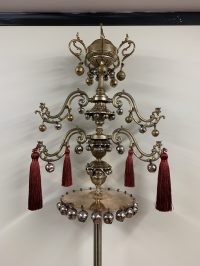
As you already know, I am really interested in historical percussion and performance. I have always wanted to make a Turkish crescent to play early music, so I finally jumped into it and made my own jingle Johny. Before we get into the specific making-process, I would like to introduce you to this instrument. A Turkish crescent (also known as “chinesco”, “chapeau chinois”, “pavillon chinois”, “schellenbaum”, “cevgen”, “cappel cinese”, “padiglione cinese”, “mezza luna”…) is an instrument dating back many centuries, but it was known to Europeans during the 16th-century due to the wars against the Ottoman Empire, being used by its elite troops, the janissaries. It was tremendously popular as a military instrument (both in wind bands and orchestras) until the second half of the 19th-century, falling into oblivion since then. Lully, Haydn, Ferdinando Paer, Beethoven, Berlioz, etc., used it and it was an irreplaceable member of the sistri, which were part of the bassa musica in Italian opera from the ottocento.
"Gabinetto armonico" (Filippo Bonanni, 1723). Public domain.
1º Régiment étranger. Chapeau chinois. Begnini.
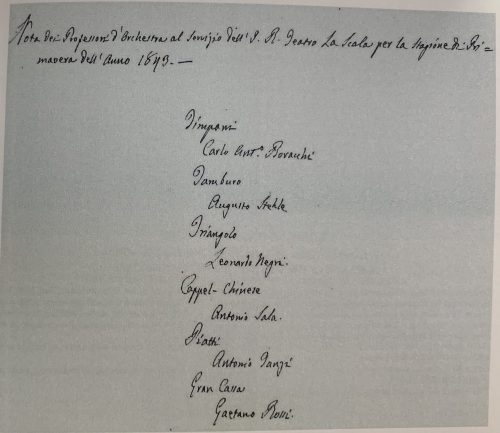
Here we can see a manuscript note featuring the names of the percussionists comprising the percussion section at Teatro La Scala during the 1843 spring season. We can see that the Turkish crescent (“Cappel-Chinese”) was part of it (it ALWAYS was, and it was ALWAYS played doubling the bass drum and cymbal part. It was never written but it was understood. That popular it was. See Lichtenthal, Picchianti, Dacci et alli.). We can also see that the bass drum and the cymbals were played by two separate percussionists, which debunks the myth about these two instruments being played by just one performer in Italian opera (this myth is also debunked by existing hand bills, poster bills, pay rolls, engravings, paintings and letters proving that they were played by two separate percussionists). Note also the presence of a drum (“Tamburo”) which, given the date (1843), we can deduct that “Nabucco” was still being performed (it was premiered in 1842). “Nota dei professori d´orchestra al servizio dell I. R. Teatro La Scala per la stagione di primavera dell´anno 1843. Timpani: Carlo Antonio Boracchi, tamburo: Augusto Stehle, triángolo: Leonardo Negri, capell-chinese: Antonio Sala, piatti: AntonioTangi, gran cassa: Gaetano Rossi”.
"Timpani and percussion instruments in 19th-century Italy". Renato Meucci.
This project started visiting the local flea market, where I got a horrendous lamp. Ugly, but perfect for the purpose. I completely dismantled it and cleaned every single piece.
I built myself an instrument that was tremendously popular in the 19th-century, but it fell into oblivion when orchestras (and specially the brass section) became louder, the bass and the cymbals became bigger (thus louder) and the Turkish crescent could not compete in volume anymore, making it obsolete and unfit for the “new” orchestra.
It is an interesting and indispensable instrument in historical performance, where I have used it to much delight of conductors and colleagues. You can see it in action HERE, where I am playing Rossini´s “Barber of Seville” oberture with the Asturias Symphony Orchestra.
Would you add a Turkish crescent to your section? 😉 .